

How AI Chatbots are Driving Massive ROI for Independent Tour and Trekking Operators
The travel industry is undergoing a massive shift. The days of manual email chains, delayed WhatsApp replies, and static “Contact Us” forms are rapidly coming to an end. Today’s travelers expect instant gratification and hyper-personalized service. If an international tourist is researching a mountain expedition or a regional homestay at 2 AM your local time, they will not wait for your office to open. They will simply book with the competitor whose website answers their questions immediately.
For independent tour operators, trekking guides, and boutique travel agencies, adopting an AI chatbot is no longer just a neat tech feature to look modern—it is a critical revenue strategy. Large Language Model (LLM) chatbots now act as 24/7 digital booking agents, capturing leads, answering complex itinerary questions instantly, and fundamentally transforming how travel businesses scale.
What is an AI Travel Agent? (Moving Beyond Simple Chatbots)
When most travel operators hear the word “chatbot,” they think of the frustrating, old-school rule-based bots from five years ago (“Press 1 for bookings, Press 2 for cancellations”). Those bots ruined the customer experience.
Modern AI travel agents are entirely different. Powered by Generative AI and Natural Language Processing (NLP), these SaaS (Software as a Service) tools can read your entire website—every blog post, every pricing table, and every destination guide—and converse naturally with your potential clients.
Instead of forcing users through a rigid menu, an LLM-powered bot understands context. If a user asks, “Is the weather suitable for a family trip in October, and do you offer vegetarian meals?”, the AI processes both questions simultaneously, retrieves the exact data from your site, and responds with the nuanced expertise of a local guide.
The Revenue Engine: Why You Must Adopt AI in 2026

Implementing AI automation directly boosts your bottom line by plugging the leaks in your sales funnel. Here is exactly how an AI agent acts as a revenue engine for your tourism business:
1. Capturing Off-Hour Global Conversions
Travel is a global, multi-timezone business. When your local team is asleep, an AI agent acts as a relentless digital sales rep. By instantly answering highly specific queries, the AI removes friction. It guides the user directly to the payment gateway while their booking intent is at its absolute peak. Industry data shows that operators implementing AI capture up to 30% more direct bookings simply by being available 24/7.
2. Context-Aware Automated Upselling
A well-trained AI doesn’t just answer FAQs; it actively sells. Because LLMs understand the context of a conversation, they can offer hyper-relevant upgrades. For instance, if a customer is finalizing a booking for a local homestay in a village like Gauchar, the AI can naturally interject: “I see you’re booking our authentic village stay. Would you like to add a guided sunrise trek to the local temple, or perhaps upgrade your meal plan to include regional delicacies for just $15 more?” This conversational upselling can increase your average order value (AOV) by 10% to 15%.
3. Recovering Abandoned Bookings
High-ticket travel packages often have high drop-off rates because travelers get overwhelmed by logistics. If a user builds a custom 7-day trekking itinerary but hesitates at the checkout page, an AI agent can proactively engage them: “I see you’re looking at the high-altitude trek. Did you know we provide all the heavy camping gear so you don’t have to fly with it? Do you have any questions before finalizing?” Addressing hidden anxieties in real-time saves bookings that would otherwise be lost to competitors.
4. Drastically Reducing Operational Overhead
By allowing the AI to deflect 70% to 80% of repetitive questions (like packing lists, route maps, permit requirements, and cancellation policies), you free up your human staff. You aren’t replacing your team; you are automating the noise so they can focus on closing complex, high-margin group tours and building relationships with VIP clients.
Case Study: Automating High-Altitude Trekking Inquiries
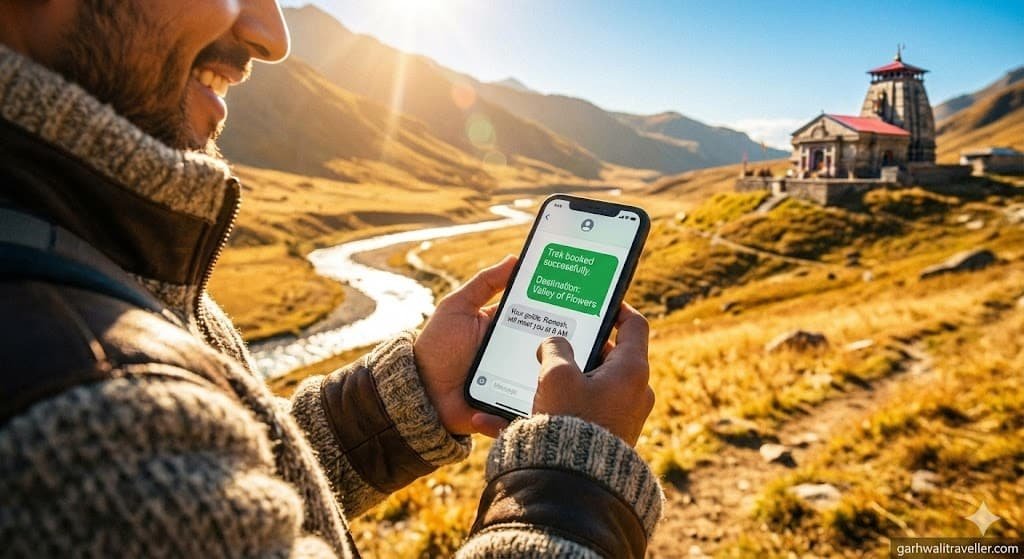
To understand the power of this technology, let’s look at a localized scenario. Imagine an international tourist from the UK wants to book a challenging Himalayan trek, such as the Kedarnath route, but they are anxious about the logistics.
Instead of waiting 12 hours for an email reply, they interact with the AI agent on the operator’s website:
Traveler: “I want to do the 5-day trek in late September. Do I need to bring my own sleeping bag, and what happens if I get altitude sickness?”
AI Agent: “September is a beautiful time for that route with clear mountain views! We provide premium, sub-zero sleeping bags for all our trekkers, so you don’t need to bring your own. Regarding altitude, our guides carry portable oxygen cylinders and oximeters at all times, and our itinerary includes a mandatory acclimatization day at the base camp. Would you like me to send you the full day-by-day itinerary and the booking link?”
Traveler: “Yes, please send the link.”
In less than 30 seconds, the AI has handled a complex safety objection, highlighted the company’s premium gear, and pushed the user to the checkout page.
Deep Dive: Top AI Chatbot Platforms for Travel and Tourism Sites
Not all AI chatbots are created equal. As a travel business, you need a platform that is reliable, won’t make up fake information (known as “hallucinating”), and is easy to update as your tour prices change. Here is a detailed breakdown of the best platforms on the market and how to use them.
1. Chatbase: Best for Independent Operators and Quick Setup
Chatbase is a powerhouse for non-technical users. It allows you to build a custom GPT model simply by dragging and dropping your existing documents or pasting your website URL.
- How it works for travel: You don’t need to code. If you have a 10-page PDF detailing your Kedarnath Yatra itinerary, you just upload it to Chatbase. The AI instantly reads it and becomes an expert on that specific document.
- Key Travel Features:
- Auto-Sync: You can set it to automatically re-crawl your website every week. If you update the price of a homestay on your site, the chatbot learns the new price instantly.
- Multi-source Training: You can train it on a mix of text files, Word documents, and live URLs simultaneously.
- The Verdict: Ideal for local travel bloggers or independent trekking guides who want an AI assistant up and running in under 20 minutes without touching a single line of code.
2. Botpress: Best for Advanced Booking Workflows
If you want your bot to do more than just answer questions—if you want it to actually check availability and process reservations—Botpress is the enterprise-grade choice. It uses a visual “node-based” canvas where you design the flow of the conversation.
- How it works for travel: Botpress excels at API integrations. You can connect the chatbot directly to your Google Calendar or your booking software.
- Key Travel Features:
- Action Execution: If a user asks, “Are there any rooms available in Gauchar for October 12th?”, Botpress can be programmed to look up your live calendar, confirm the date, and securely collect the user’s email to hold the reservation.
- Complex Logic: You can build specific paths. For example, if a user selects “Luxury Tour,” the bot routes them to a premium sales script; if they select “Budget Trek,” it offers your standard packages.
- The Verdict: Steeper learning curve, but massive payoff for medium-to-large travel agencies looking to fully automate their booking pipeline.
3. Dante AI: Best for Accuracy and Multi-Lingual Support
For travel operators dealing with high-ticket international clients, accuracy is everything. You cannot afford an AI that promises a tourist a free helicopter ride that doesn’t exist. Dante AI is built strictly around factual accuracy.
- How it works for travel: Dante AI forces the underlying language model to only answer using the context you provided. If the answer isn’t in your files, it politely declines to answer and asks for the user’s email instead.
- Key Travel Features:
- Zero Hallucination Guardrails: Strict adherence to your uploaded data.
- Native Translation: It automatically detects the language of the user. If a French tourist asks a question in French, the bot translates your English knowledge base, formulates the answer, and replies in perfect French.
- The Verdict: The absolute best choice for operators targeting international tourists who want a safe, heavily guarded, and multilingual AI representative.
The Master Guide: How to Train and Deploy Your AI Travel Agent

Integrating an AI bot is not just about pasting a snippet of code onto your website; it is about proper training. Here is the exact blueprint to deploy an AI that acts like a seasoned local guide.
Step 1: Build Your Knowledge Base (The Brain)
An AI is only as smart as the data you feed it. Before signing up for a platform, gather your assets.
- Create a “Master FAQ” Document: Write down the top 50 questions you get asked on WhatsApp or email. Cover everything: altitude sickness, packing lists, cancellation policies, refund timelines, and weather expectations for different seasons.
- Format Your Itineraries: Ensure your tour packages are clearly formatted in PDFs or live URLs with distinct headings for “Day 1”, “Day 2”, “Inclusions”, and “Exclusions”. Clean data prevents the AI from getting confused.
Step 2: Prompt Engineering (Setting the Persona)
Every AI platform allows you to set “System Instructions.” This tells the bot who it is and how to behave. Do not skip this step.
- Example Travel Prompt: “You are a friendly, highly experienced local mountain guide and booking assistant for [Your Company Name]. Your goal is to help users find the perfect trek and encourage them to book. Speak in a warm, encouraging, and professional tone. Never offer discounts. If you do not know the answer to a question, say: ‘I want to make sure I give you the most accurate information. Let me have our lead guide email you—what is your address?'”
Step 3: Implement Human Handoff and Lead Capture
The goal of the AI is to handle the heavy lifting, but human touch closes the big deals.
- Configure your bot to ask for a name and email/WhatsApp number early in the chat.
- Set up a “Human Handoff” trigger. If a user types “I want to speak to a person” or asks a highly complex custom itinerary question, the bot should immediately ping your phone or email with the chat transcript so you can step in seamlessly.
Step 4: Testing and Web Deployment
Before going live, use the platform’s testing environment. Ask the bot trick questions to see if it breaks its guardrails (e.g., “Can I get a 50% discount?”). Once it passes your tests:
- Generate the embed code (usually an iframe or a JavaScript snippet).
- Paste it into the header or footer of your website. If you use WordPress, plugins like ‘WPCode’ make this a one-click process.
- The bot will now appear as a professional chat widget in the bottom right corner of your site, ready to capture global traffic.
Step-by-Step: How to Integrate an AI Bot into Your Travel Website
Ready to deploy your own automated travel agent? Here is how to execute the integration:
- Data Scraping & Training: Choose a platform like Chatbase. Feed the AI your existing blog posts, destination guides, pricing tables, and a document of your most frequently asked questions.
- Prompt Engineering for Travel: Set the bot’s “personality” in the system instructions. Tell it to act like a friendly, authoritative local mountain guide. Establish strict guardrails—for example, explicitly instruct the bot: “Never offer discounts. If a user asks for a cheaper price, direct them to our off-season travel guide.”
- Lead Capture Integration: Configure the bot to ask for the user’s name and WhatsApp number or email address early in the conversation. This ensures that even if the user doesn’t book immediately, your human sales team can follow up the next day.
- Deployment: Copy the provided API webhook or JavaScript snippet and paste it into your website’s header (or use a dedicated WordPress plugin). Your bot will instantly appear in the corner of your site, ready to sell.
The Future of Travel is Conversational
Artificial intelligence is no longer reserved for massive corporations like Expedia or Booking.com. It is an accessible, high-ROI tool that allows independent operators and local travel blogs to compete on a global scale. By adopting an AI travel agent today, you are future-proofing your business, scaling your customer service, and ensuring you never miss a booking while you sleep.