
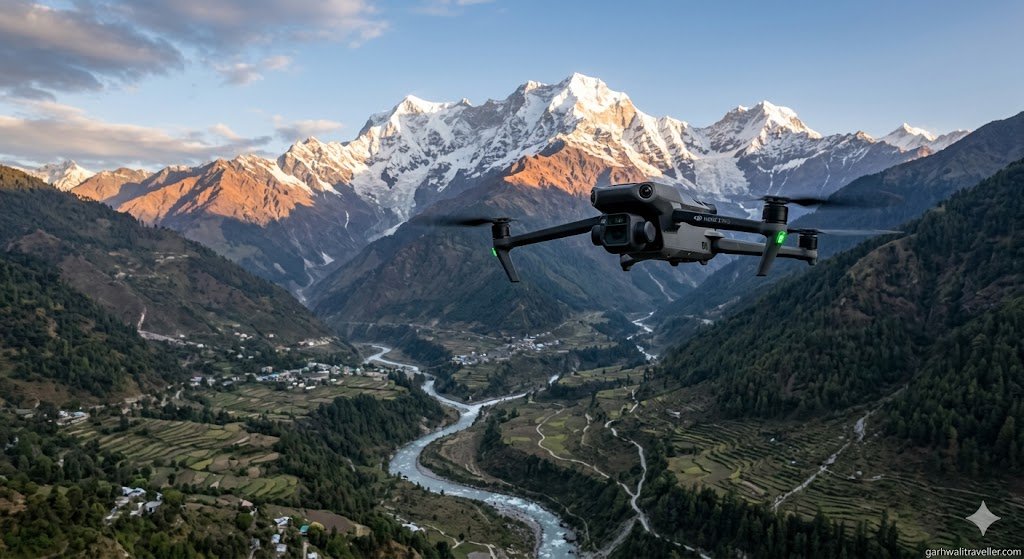
Flying Drones at Kedarnath 2026: Police Permissions, Rules & Gear Guide
Flying Drones at Kedarnath 2026: Police Permissions, Rules & Gear Guide
The Garhwal Himalayas offer some of the most breathtaking aerial cinematography opportunities on the planet. However, if you are planning to bring your DJI Air 3S or Mini 3 Pro to Kedarnath this Yatra season, relying on outdated YouTube tutorials will get your gear confiscated.
As of April 2026, the Badri-Kedar Temple Committee (BKTC) and the local police have initiated a massive crackdown on digital devices. The days of launching a drone from the temple courtyard to get a top-down reel are permanently over.
This guide breaks down exactly what is illegal, how to navigate the strict offline and online police permissions, and the harsh physical realities of flying at 11,500 feet.
The 2026 Kedarnath Drone Ban: What is Actually Illegal?
The 2026 Yatra season has introduced unprecedented restrictions to maintain the sanctity of the shrine and manage the massive crowds.
- The 80-Meter Perimeter Rule: The BKTC has enforced a strict “mobile-free zone” inside the main temple premises. Drones, cameras, and mobile phones are completely prohibited within an 80-meter radius of the shrine.
- Law Enforcement Stance: Rudraprayag Superintendent of Police Niharika Tomar has officially confirmed that strict action is being taken against unauthorized drone flights. Police have already confiscated drones flying illegally over the temple courtyard.
- The Cloakroom System: Pilgrims are now required to deposit all electronics in secure locker facilities established by the temple administration before entering the restricted zones.
How to Get Drone Permissions for the Mandakini Valley
Flying a drone in the Kedarnath region is no longer a casual activity. Because the temple falls under a highly sensitive zone, relying solely on online DGCA apps will result in your equipment being grounded. Here is the exact, two-tiered process for securing legal flight clearance.
Step 1: DigitalSky & NPNT Compliance
Before you even pack your drone, you must comply with the central Directorate General of Civil Aviation (DGCA) regulations.
- UIN Registration: Any drone weighing over 250 grams (which includes the DJI Mini 3 Pro with a plus battery, and certainly the DJI Air 3S) falls into the Micro category or above and must possess a Unique Identification Number (UIN).
- NPNT (No Permission, No Takeoff): India’s airspace mandates NPNT compliance. You must log into the DigitalSky platform and generate a flight plan for the Green/Yellow zones in the Rudraprayag district.
Step 2: The Offline Bureaucracy (Local Police & BKTC)
In the Mandakini valley, the local administration supersedes the DigitalSky map. To get clearance for locations outside the temple perimeter, you must visit two offices:
- The Rudraprayag SP Office: Submit a formal application to the Superintendent of Police in Rudraprayag (or the designated local police outpost at Sonprayag/Phata).
- What to include: A printed copy of your DigitalSky UIN, your Aadhaar/Passport, and a specific “Flight Route Map.” You must explicitly state that your flight path will avoid commercial helicopter routes and will not breach the 80-meter temple perimeter.
- The Badri-Kedar Temple Committee (BKTC): If your planned flight path captures the Kedarnath temple from a distance, you need a No Objection Certificate (NOC) from the BKTC office. The committee is highly protective of the shrine’s sanctity and will deny any request that commercializes the temple without prior agreement.
Pro Tip for Calibration & NPNT Testing: Do not wait until you are at 11,500 feet to test your DGCA app or calibrate your compass. Stop in a lower-altitude town with open spaces—like the local airstrip area in Gauchar—to ensure your NPNT unlocks and your firmware is updated before driving up into the restricted, zero-network mountain valleys.
High-Altitude Drone Physics: The 11,500 ft Reality
Flying at sea level is one thing; flying in the Garhwal Himalayas is an entirely different beast. At an elevation of 11,500 feet, the laws of aerodynamics shift dramatically.
Air Density vs. Rotors
The air at Kedarnath contains roughly 35% less air pressure than at sea level. Because drones rely on air density to generate lift, this thin air forces your drone’s motors to work exponentially harder. To maintain a steady hover, the rotors must spin at a significantly higher RPM. If you push the drone into “Sport Mode” in these conditions, you risk overloading the electronic speed controllers (ESCs), triggering a mid-air shutdown.
The Battery Slaughter: DJI Air 3S & Mini 3 Pro
Altitude and near-freezing mountain temperatures absolutely decimate lithium-polymer (LiPo) and lithium-ion battery efficiency. Cold chemistry means the voltage drops much faster under load, triggering early low-battery warnings.
- DJI Mini 3 Pro: At sea level, you might get 34 minutes out of the standard Intelligent Flight Battery. At Kedarnath, factoring in thin air and high rotor RPM, that flight time plummets to roughly 15 to 18 minutes.
- DJI Air 3S: While it handles wind shear far better than the Mini series, its advertised 45-minute flight time will realistically max out at 22 to 25 minutes.
Mandatory IMU and Compass Calibration
Before throttling up in the Mandakini valley, you must calibrate both the IMU and the compass. The Himalayas are massive, iron-rich geological formations that create intense, localized magnetic interference. The altitude difference between where you unboxed the drone and the Kedarnath shrine is massive. Skipping calibration frequently causes the drone to drop GPS lock and enter “ATTI mode” unprompted, leading to catastrophic flyaways. Always perform a fresh, slow figure-eight calibration on a flat surface away from metal fences and reinforced concrete.
The “Legal Shot List”: Where You Can Actually Fly
With the proper police permissions secured, there are spectacular locations outside the restricted zone where you can legally capture breathtaking cinematic footage.
1. The Bhairav Nath Temple Ridge
Located about 500 meters uphill to the south of the main Kedarnath shrine, this ridge offers a sweeping, wide-angle landscape shot of the entire valley, with the Kedardome and Chaukhamba peaks towering in the background. Beware of sudden updrafts coming from the valley floor, and keep your drone within a visual line of sight (VLOS).
2. The Mandakini River Approach
Setting up on the banks of the glacial Mandakini river (well outside the 80-meter perimeter) allows for low-altitude tracking shots over the rushing water. Since river valleys act as natural wind tunnels, fly close to the water with caution and ensure your Return-to-Home (RTH) altitude is set high enough to clear the boulders if the signal drops.
3. The Lincholi and Base Camp Areas
These staging areas are excellent for capturing the sheer scale of the Himalayan trek, including the winding mule tracks and dramatic cloud inversions. Never fly directly over crowds, and keep your drone’s noise pollution away from resting animals.
🚫 The Ultimate Danger Zone: Helicopter Flight Paths
Avoiding the commercial helicopter routes is a matter of life and death. Shuttles from Sirsi, Phata, and Guptkashi run continuous sorties during daylight hours. Never fly your drone in the airspace directly south of the Kedarnath helipad. Always coordinate with local authorities on where the active chopper lanes are before powering on your drone.
5. Required Gear & Accessories for Himalayan Flying
Your standard out-of-the-box setup will not survive the elements. To capture cinematic footage without destroying your hardware, you must upgrade your kit.
Intelligent Flight Batteries & Thermal Management
You need a minimum of three High-Capacity Intelligent Flight Batteries. Keep your spare batteries inside a thermal pouch or an inner jacket pocket close to your body heat. Never insert a freezing battery into your drone; the sudden power draw will cause an immediate voltage drop and trigger a forced landing.
ND/PL Filters: The Ultimate Glare Solution
At 11,500 feet, the UV index is intense, and the glare reflecting off the snow-capped peaks and the Mandakini river will instantly blow out your highlights.
- ND16/PL to ND32/PL: Essential for mid-morning flights to control shutter speed and cut through atmospheric haze.
- ND64/PL: Mandatory for flying between 11:00 AM and 2:00 PM when the midday sun bounces harshly off the stone and glaciers.
Weatherproof Hard Cases
The 16-kilometer trek from Gaurikund is brutal. A soft canvas bag will result in crushed gimbals or snapped propeller arms. Invest in a custom-cut, IP67-rated waterproof hard case (like a Pelican or Nanuk) to survive the narrow mule track and violent rainstorms.
Final Thoughts: Fly Smart, Fly Legal
Capturing the sheer scale of the Garhwal Himalayas from the sky is an unmatched experience, but the 2026 regulations leave zero room for error. Breaching the BKTC temple perimeter guarantees immediate gear confiscation, and DigitalSky NPNT compliance is useless without a physical NOC from the Rudraprayag police.
Whether you are pushing a lightweight DJI Mini 3 Pro against the valley headwinds or relying on the heavier DJI Air 3S for stable ridge shots, technical preparation is your best insurance policy.
What drone are you packing for your Kedarnath Yatra this season? Are you stuck on the DigitalSky UIN registration process, or unsure about which ND filters to buy? Drop your questions in the comments below, and let’s get you cleared for takeoff!
