
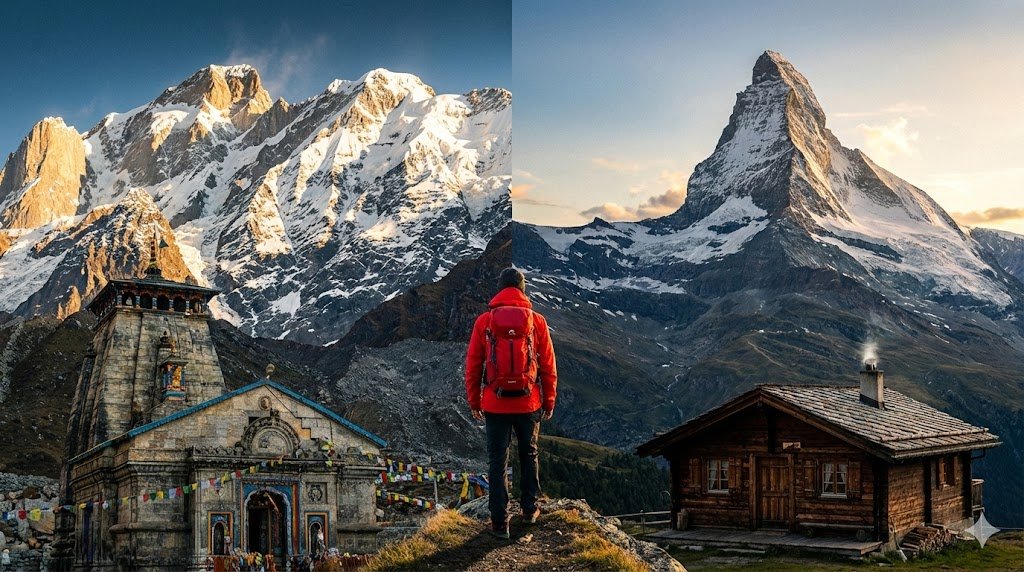
The Ultimate High-Altitude Packing List: From the Garhwal Himalayas to the Swiss Alps
If you have ever stood at the summit of Chandrashila or gazed at the massive Chaukhamba massif, you already know the biting cold and unpredictable weather of high-altitude environments. But how does packing for the Indian Himalayas compare to prepping for a trek through the Swiss Alps?
While the landscapes differ—from the ancient trails of Rudraprayag to the pristine alpine villages of Switzerland—the core principles of survival, comfort, and capturing the perfect shot remain exactly the same.
Here is the definitive high-altitude packing guide designed to seamlessly take you from the trails of Uttarakhand to the heart of Europe.
The Altitude Reality Check: Himalayas vs. Alps
A common misconception is that the Alps require less serious gear than the Himalayas. While the absolute peaks of the Himalayas tower over Europe, the trekking routes you will actually walk share remarkably similar elevations.
Understanding these precise numbers is crucial for packing the right layers:
- Nanda Devi (Himalayas): 7,816 m (25,643 ft) – India’s highest peak located entirely within the country.
- Matterhorn (Alps): 4,478 m (14,692 ft) – Switzerland’s iconic, pyramid-shaped peak.
- Jungfrau (Alps): 4,158 m (13,642 ft) – The crown jewel of the Bernese Alps.
- Chandrashila Peak (Himalayas): ~4,000 m (13,123 ft) – The popular summit situated just above the Tungnath temple.
- Tungnath (Himalayas): 3,680 m (12,073 ft) – The highest Shiva temple in the world.
Notice the overlap? If your body and gear can handle a winter ascent to Chandrashila, you are physically and logistically equipped to handle the high-altitude passes around the Matterhorn and Jungfrau.
The 3-Layer Clothing System
Whether you are preparing for the deep winter snows detailed in our Auli travel guide or taking the Jungfrau Railway up to the “Top of Europe,” mastering the 3-layer system is non-negotiable for mountain survival.
- Base Layer (Moisture Management): Avoid cotton at all costs. Opt for Merino wool (200gsm is ideal). It wicks sweat away during steep ascents and naturally resists odor, which is essential for multi-day treks.
- Mid Layer (Insulation): A high-quality fleece or a compressible down jacket (800-fill power). This traps your body heat against the core.
- Outer Layer (Weather Protection): A Gore-Tex hardshell jacket. It must be 100% windproof and waterproof to protect against sudden Himalayan blizzards or Alpine rainstorms.
High-Altitude Tech & Photography Gear
Capturing cinematic travel footage around pristine alpine waters—whether that is the tranquil Deoriatal Lake or the glacial lakes of Switzerland—requires highly specific preparation. Cold temperatures drain lithium-ion batteries at an alarming rate.
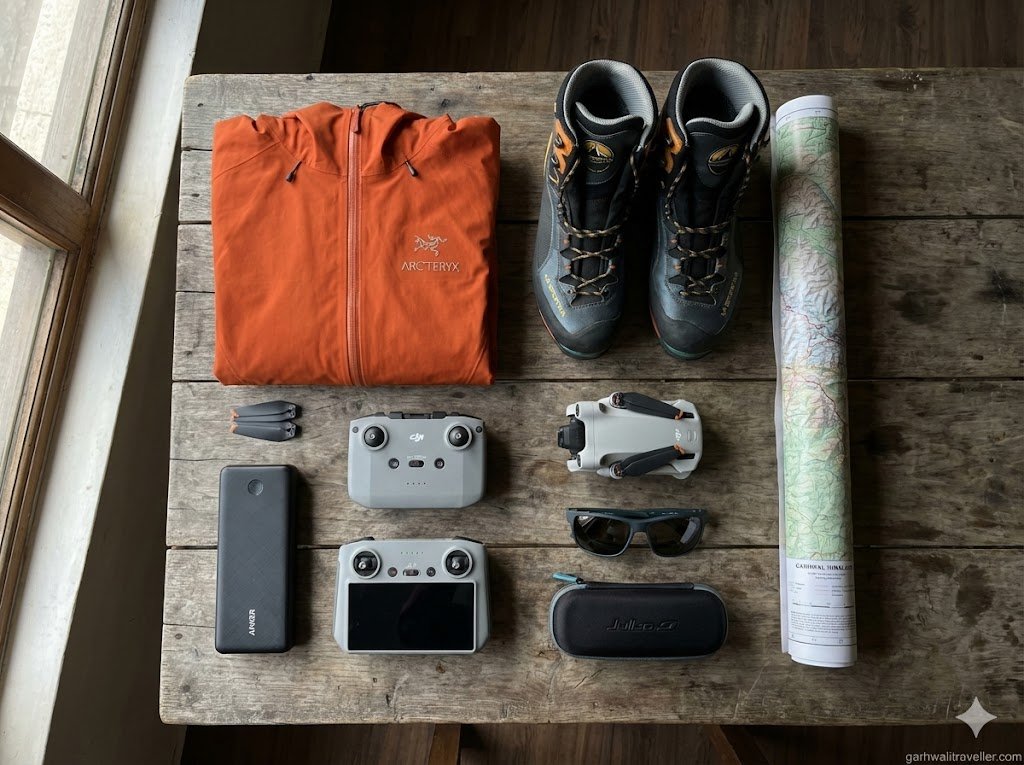
- Power Banks & Thermal Protection: Pack a minimum of a 20,000mAh power bank. Keep your power bank and spare camera batteries in an inner jacket pocket close to your body heat, not in your external backpack.
- Drone Logistics (Sub-250g Category): A sub-250g drone like the DJI Mini 3 Pro is the ultimate travel companion for both regions. It handles high-altitude mountain winds surprisingly well and circumvents the heavy registration laws required for heavier drones in European airspace. Just remember to pack extra propellers; the thin mountain air requires higher RPMs to maintain lift.
- Lighting on the Go: If you are shooting portraits or interviews on the trail, leave the heavy studio softboxes at home. Pack a pocket-sized, bi-color LED light panel.
Footwear and Trekking Essentials
- Boots: Stiff-soled, waterproof trekking boots with high ankle support. Ensure they are broken in well before you hit the trail, whether you are navigating the rocky ascent of the Kartik Swami Trek or descending a path in Zermatt.
- Microspikes: Absolute essentials for early spring or late autumn treks where ice still coats the trails.
- Trekking Poles: Often overlooked, poles reduce the impact on your knees by up to 20% during steep descents.
The Sleep System: Himalayan Tents vs. Swiss Alpine Huts
This is where packing for the two regions diverges the most, and it is a crucial detail for international travelers to understand.
- The Garhwal Reality (Heavy Duty): When camping out on the vast, open Bugyals of Uttarakhand or trekking off-beat routes, you are often relying on tents. You absolutely need a four-season sleeping bag with a “comfort rating” of at least -10°C to -15°C (14°F to 5°F), plus a high-R-value insulated sleeping pad.
- The Swiss Reality (Ultra-Light): The Swiss Alps utilize a massive network of SAC (Swiss Alpine Club) mountain huts. These huts are structural, often heated, and provide thick blankets. Therefore, carrying a heavy sleeping bag is a rookie mistake in Europe. You only need to pack a lightweight silk sleeping bag liner.
The Unforgiving Alpine Sun: Eye and Skin Protection
Many beginners prepare for the cold but forget that UV radiation increases by roughly 10% to 12% for every 1,000 meters of elevation gained.
- Category 4 Glacier Glasses: Standard sunglasses will not protect you from snow blindness. You need specialized glacier glasses with Category 4 lenses and side shields to block the intense UV rays reflecting off the snow.
- High-Altitude Skincare: Pack a broad-spectrum sunscreen of SPF 50+ (mineral-based formulas freeze less easily than chemical ones) and a heavy-duty, SPF-rated lip balm.
Navigation & Emergency Tech
While popular trails are well-marked, whiteouts can happen instantly in both mountain ranges, obscuring the path.
- Satellite Messengers: As we have covered in our Network Connectivity Guide for Garhwal, cell service is notoriously spotty in deep mountain valleys, and it easily drops in the remote cols of the Swiss Alps. A two-way satellite communicator (like the Garmin inReach Mini 2) is a high-ticket essential.
- Redundant Power: Keep a dedicated, small 5,000mAh power bank specifically reserved for your phone/GPS, sealed in a waterproof dry bag.
- Digital & Physical Maps: Download offline topographical maps via apps like Komoot or AllTrails Pro. However, always carry a physical, waterproof topographical map and a compass as a fail-safe.
Hydration and First Aid
- Insulated Water Bottles: Standard plastic bottles will freeze solid at these altitudes. Use a vacuum-insulated flask to keep water liquid, and pack hydration multiplier packets (electrolytes) to combat altitude-induced dehydration.
- Altitude Sickness Mitigation: The air is just as thin at 4,000 meters in Switzerland as it is in India. Stay hydrated, ascend slowly, and consult a doctor about carrying Diamox (Acetazolamide) as a preventative measure.
The Fuel: Trail Nutrition Strategies
Altitude suppresses the appetite while simultaneously burning calories at an accelerated rate.
- The Alpine Luxury: In the Alps, you can often stop at a mountain hut mid-hike for a hot plate of Rösti or a bowl of soup. You only need to pack daily snacks like energy gels, nuts, and chocolate.
- The Himalayan Haul: While you might fuel up at excellent Local Garhwali Food Outlets in Srinagar before hitting the trailhead, once you are deep in the remote Garhwal Himalayas, the distances between functional dhabas can be vast. You must pack calorie-dense, lightweight fuel like dehydrated meals, roasted chickpeas (chana), jaggery (gur), and high-protein trail mix.
The Ultimate Logistics: Reaching the Trailhead
Just as you might rely on our comprehensive Shared Taxi and Bus Guides for Garhwal to reach remote villages in Uttarakhand, navigating European mountain transport requires planning. Switzerland relies heavily on an incredibly efficient, but expensive, network of funiculars, cable cars, and alpine trains (like the Glacier Express). Researching transport passes ahead of time is just as vital as packing the right boots.
