Chakrata to Koti Kanasar: How to Vlog a Himalayan Snow Drive Without Getting Stuck
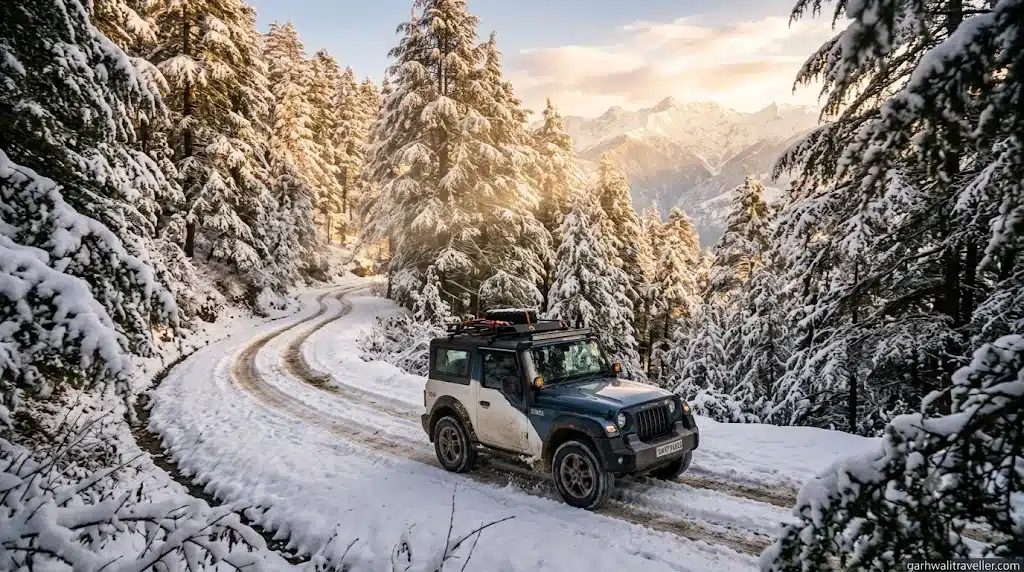
Vlogging the 26-kilometer mountain drive from Chakrata to Koti Kanasar in winter requires balancing high-risk driving safety—navigating shaded black ice patches—with camera rigging logistics to capture cinematic car b-roll. Elevated at 2,166 meters (~7,100 feet), this stretch through the Jaunsar-Bawar region passes under ancient deodar canopies and dense snow cover. It provides a far less crowded alternative to saturated road trips like Mussoorie or Manali.
Driving in sub-zero Himalayan conditions demands technical preparation. A single skid on black ice will ruin a shoot, and cold wind shear will compromise audio without the right equipment.
The Vlogging & Rigging Setup for Road Trips
Capturing a dynamic travel vlog while behind the wheel requires a dual-camera setup to maintain visual pacing without distracting the driver.
1. External & Dashcam Angle Options
- The Hood/Fender Suction Mount: Use a heavy-duty tri-suction cup mount with a safety tether tied to the side mirror. Mount an action camera in 4K/60fps with a CPL (Circular Polarizer) filter to cut glare from snow reflections.
- The Driver’s Perspective (P.O.V.): Position a small action camera on a neck mount or direct windshield suction cup facing inward at a 45-degree angle to capture both the driver’s reactions and the snowy road through the side window.
2. Audio Management Against Himalayan Wind
High-altitude mountain passes create intense wind noise when windows are cracked open for B-roll.
- Deadcat Muffs Are Mandatory: Equip all external wireless lavalier microphones with high-density furry deadcats.
- Interior Audio Placement: Mount a compact shotgun microphone on your center console, pointed away from heater vents, to record cabin conversation without engine hum interference.
4 Cinematic Shooting Locations Along the Route
| Location & KM Mark | Visual Highlight | Recommended Focal Length | Driving Hazard Level |
| KM 8: Chilmiri Neck Bypass | Panoramic Himalayan range view during morning light | 24mm – 70mm zoom | Low (Paved, wide shoulders) |
| KM 14: Deoban Forest Cut-Off | Dark, dense deodar forest tunnel with overhanging snow | 16mm Ultra-wide (Gimbal pass-by shot) | High (Frequent black ice in shadows) |
| KM 20: Koti Village Hairpins | Wooden village houses stacked on snowy terraced ridges | 85mm or 70-200mm Telephoto compression | Medium (Narrow sharp turns) |
| KM 26: Kanasar Meadow (Bugyal) | Open snow meadow with Asia’s largest ancient Deodar tree | Drone aerial top-down / 35mm Prime | Low (Large parking area at destination) |
Driving Safety Protocol on Black Ice
1.Spot black ice before your tires touch it:Identify Invisible Hazards.
Black ice forms in permanently shaded mountain bends where snow melts during the day and freezes overnight. Look for dark, wet-looking road surfaces that do not spray water when vehicles drive over them.
2.Engine brake in low gears (1st or 2nd):Transmission Control.
Never slam on your brakes if your car begins to slide. Keep manual or automatic transmissions in 1st or 2nd gear. Let engine compression slow the vehicle down naturally when descending steep grades toward Koti Kanasar.
3.Lower tire pressure slightly or fit snow chains:Tire Preparation.
If driving a 4×2 front-wheel-drive vehicle, deflate your tires by 3–5 PSI to increase the rubber contact patch on packed snow. Carry a set of anti-skid snow chains for the drive wheels in case of sudden afternoon blizzards.
4.Pull over completely for exterior B-roll:Vlogging Safety.
Never operate handheld cameras or track shots while driving. Use designated road pull-outs near forest checkpoints to set up static tripod exterior drive-by shots.
Frequently Asked Questions
Can a hatchback or sedan complete the drive from Chakrata to Koti Kanasar in winter?
Yes, under normal winter conditions when the road has been cleared by local authorities. However, if there has been fresh, heavy snowfall within 24 hours, a 4×4 SUV or a vehicle equipped with snow chains is strongly recommended to prevent getting stuck on steep gradient turns.
Where is the ancient giant Deodar tree in Koti Kanasar located?
The famous deodar tree—considered one of the largest in Asia with a trunk circumference exceeding 6.3 meters—is located right inside the main Kanasar Forest Rest House grounds, just a short walk from the main road parking area.
How long does the 26 km drive take in winter?
While the distance is short, plan for 1.5 to 2 hours of driving time. Slow speeds are necessary due to narrow roads, single-lane forest stretches, and potential ice patches, as well as frequent stops for shooting exterior video footage.