
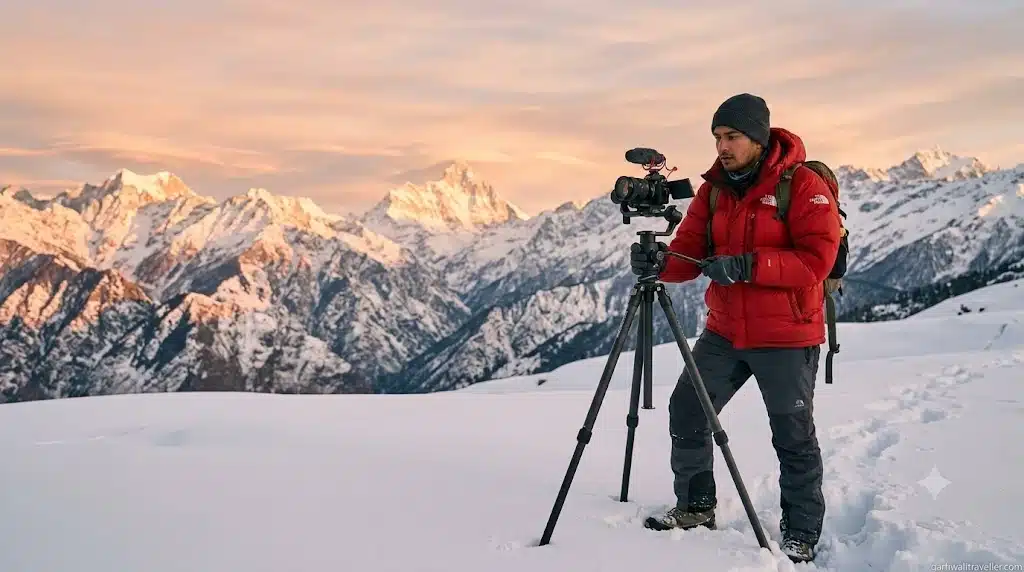
Sub-Zero Himalayan Flying: How to Keep Drone & Camera Batteries Alive in Garhwal
The secret to keeping drone and camera batteries alive in the sub-zero temperatures of the Garhwal Himalayas is pre-heating lithium-polymer (LiPo) cells to at least 15°C (59°F) before takeoff and monitoring voltage drops rather than battery percentages. When flying in high-altitude spots like Auli, Chopta, or Harsil, expect a 20% to 50% reduction in flight time. If your drone voltage drops below 3.2V per cell, the aircraft’s over-discharge protection may trigger a sudden mid-air shutdown.
Shooting winter aesthetics in Uttarakhand requires more than just a good eye—it requires technical gear management. When temperatures drop below freezing, the chemical reactions inside your batteries slow down drastically. The internal resistance increases, meaning the battery has to work harder just to maintain power, leading to aggressive voltage sag.
Here is your operational blueprint to prevent catastrophic gear failure in the snow.
The Cold Weather Drone Checklist
If you are hiking up to Tungnath or standing in the snow at Dayara Bugyal, follow this sequence to keep your drone in the air.
1.Pre-heat before stepping outside:Target: 15°C to 25°C.
Never start a drone with a cold battery. Warm your batteries in your hotel room or car heater before heading out. If you are trekking, keep the batteries in an inner jacket pocket close to your body heat, or throw a chemical hand warmer into your drone bag (avoid placing it directly against the battery contacts).
2.Enable voltage reading on your screen:Ignore the battery percentage.
Battery percentage is unreliable in the cold. In your drone’s app settings, enable “Show Voltage on Main Screen.” Keep your eyes on the voltage numbers. A fully charged LiPo cell sits at 4.2V; if it drops below 3.2V or 3.3V while hovering, land immediately.
3.The 1-Minute Hover Rule:Do not fly away immediately.
Take off and hover at eye level for 60 seconds. This forces the battery to discharge slightly, generating internal heat. Do not push the throttle hard during this warm-up phase, as sudden power spikes can crash a cold battery.
4.Pad your Return to Home (RTH) buffer:Plan for a 15-minute flight.
Cold air and high altitude (which means thinner air and less lift per RPM) drain batteries exceptionally fast. If your drone normally flies for 30 minutes, assume you only have 15 minutes in Garhwal’s winter conditions. Bring it back when you hit 40% battery, not 20%.
Protecting Mirrorless and DSLR Cameras
Drones are not the only gear at risk. Mirrorless cameras face two massive threats in Himalayan winters: battery drain and lens condensation.
- The Ziploc Condensation Hack: When you bring a freezing cold camera from a -5°C outdoor shoot into a heated Garhwal homestay, the temperature shock will instantly cause condensation to form inside your lens and on your sensor. Before going inside, seal your camera in an airtight Ziploc bag. The condensation will form on the outside of the bag, leaving your gear perfectly dry. Wait until the camera reaches room temperature before opening the bag.
- Dummy Batteries & Power Banks: For long winter timelapses of the Panchachuli peaks or the Milky Way, standard camera batteries will die quickly. Use a “dummy battery” connected via USB-C to a high-capacity power bank. You can wrap the power bank in a thick sock with a hand warmer to keep the power flowing all night.
- Avoid Breathing on the Viewfinder: In sub-zero temperatures, the moisture from your breath will instantly freeze on your LCD screen and viewfinder. Hold your breath when bringing the camera to your eye, or wear a buff over your nose and mouth.
Sub-Zero Gear Troubleshooting Quick Reference
| Issue | Cause | Immediate Action |
| Drone won’t take off / Motor Error | Propellers are frozen, or sensors are iced over. | Wipe down the drone. Check props for ice. Do not force take-off. |
| Sudden Battery Drop (e.g., 80% to 20%) | Severe voltage sag due to extreme cold. | Land immediately. Swap to a pre-warmed battery. |
| Lens fogging during flight | Moisture from snow or clouds hitting cold glass. | Bring the drone back. Wipe the lens and power cycle to utilize internal heat. |
| Controller disconnects | Phone or tablet battery died from the cold. | Keep your phone plugged into a power bank, or attach a hand warmer to the back of the device. |
Frequently Asked Questions
Can I fly a DJI drone at high altitudes like Chopta or Auli during winter?
Yes, but you must account for thin mountain air and cold temperatures. Thinner air forces drone motors to spin faster to generate lift, which burns battery power quicker. Always hover for 60 seconds after takeoff to warm the LiPo battery cells before flying away, and set your Return-to-Home (RTH) threshold to at least 40%.
What is the lowest operating temperature for standard camera batteries?
Most standard mirrorless and DSLR lithium-ion batteries are rated for operation between 0°C and 40°C (32°F to 104°F). Below 0°C, chemical reactions slow down, causing temporary voltage drops of up to 50%. The charge isn’t permanently lost—warming the battery back up in your pocket will restore the remaining capacity.
How do I safely clean snow or frost off a camera lens without scratching it?
Never wipe wet snow or frost directly with a microfiber cloth, as hard snow crystals can scratch lens coatings. Use a rubber rocket blower first to blast away loose ice particles. If condensation or moisture remains, use a dedicated lens-cleaning tissue or a dry microfiber cloth gently in outward circular motions.
Will high altitude in Uttarakhand burn out drone motors?
High altitude won’t burn out your motors under normal conditions, but flying above 3,000 meters (9,800 feet) forces the ESCs (Electronic Speed Controllers) and motors to work harder. Avoid aggressive sports mode maneuvers and high-speed ascents, as heavy electrical draws in cold temperatures increase the risk of an instant voltage collapse.
