Shooting the Himalayan Night Sky: Kasar Devi Winter Astrophotography Guide
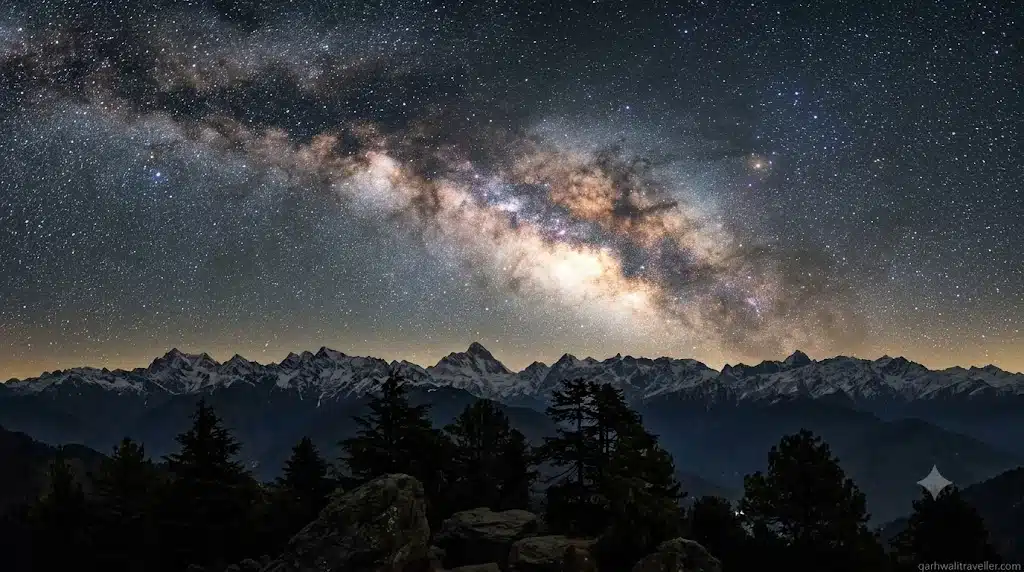
Kasar Devi in Kumaon, Uttarakhand offers Bortle Class 3 night skies and ultra-low atmospheric humidity during winter, making it one of India’s premier high-altitude spots for deep-sky and winter Milky Way photography. Situated at an elevation of 2,116 meters (~6,942 feet) along a geomagnetic ridge, the absence of dust and moisture in freezing winter air creates extreme celestial clarity. For a baseline full-frame camera setup using a 14mm f/2.8 lens, shoot at ISO 3200, 15-second shutter speed, f/2.8 aperture, and a fixed 4000K White Balance.
Why Kasar Devi Is a Unique Night Sky Location
Beyond its raw elevation, Kasar Devi sits on the Van Allen Belt—a high-energy geomagnetic field region shared by places like Machu Picchu and Stonehenge. While the metaphysical aspects attract spiritual travelers, the practical benefit for photographers is the ridge’s geographic positioning above the smog layer of the plains.
During winter (December to February), the humidity drops to near zero, eliminating atmospheric hazing. While the dense core of the Milky Way is below the horizon in northern hemisphere winters, the Winter Arch, the Orion Constellation, the Pleiades star cluster, and the Andromeda Galaxy (M31) light up the southern and western sky in high contrast.
The Master Camera Settings Matrix
Use this cheat sheet to set up your exposure depending on your sensor size and gear setup.
| Gear Setup | Lens Focal Length | Aperture | Max Shutter Speed (500 Rule) | ISO Range | Focus Method |
| Full-Frame Mirrorless | 14mm – 24mm | f/1.8 – f/2.8 | 15s – 20s | ISO 3200 – 6400 | Manual 10x Live View Zoom on bright star |
| APS-C (Crop Sensor) | 10mm – 16mm | f/2.0 – f/2.8 | 10s – 13s | ISO 1600 – 3200 | Manual focus locked on infinity line |
| Action Cam / Drone | Fixed Wide | f/2.8 | 15s – 30s (Night Photo mode) | ISO 800 – 1600 | Auto-infinity |
| Smartphone (Pro Mode) | 24mm equivalent | f/1.8 – f/1.9 | 15s – 30s | ISO 800 – 1600 | Manual distance slider to 0.95 or $\infty$ |
3 Top Night Shooting Vantage Points in Kasar Devi
- Spot 1: Kasar Devi Temple Ridge
- Foreground Idea: Stone temple bells or steps silhouetted against star trails looking toward the northern sky.
- Light Condition: Minor light leak from Almora town below on the south side; point north-northeast for dark sky framing.
- Spot 2: Crank’s Ridge (Hippy Hill)
- Foreground Idea: Pine tree canopies silhouetted against the rising Orion constellation.
- Light Condition: Pitch dark; ideal for tracking shot panoramas and deep-sky wide angles.
- Spot 3: Binsar Wildlife Sanctuary Gate Road
- Foreground Idea: Winding mountain asphalt road framed by deodar trunks with glowing sky above.
- Light Condition: True Bortle 2 darkness; zero ambient town lighting.
Technical Setup for Himalayan Astrophotography
1.Apply the 500 Rule to calculate shutter speed:Avoid Star Trails.
Divide 500 by your lens focal length (full-frame equivalent) to find the maximum exposure time in seconds before star trailing occurs. For example: $500 \div 14\text{mm} = 35.7\text{ seconds}$ (cap at 20 seconds to maintain pinpoint sharpness).
2.Manual focus using 10x Live View magnification:Critical Sharpness.
Autofocus fails in the dark. Point your lens at Sirius or Jupiter, enable 10x digital zoom on your LCD screen, and manually turn the focus ring until the light point becomes as small and sharp as possible. Tape down the focus ring so it does not slip.
3.Attach an electric USB lens heater strip:Frost Prevention.
Sub-zero night temperatures in Kumaon cause dew to freeze directly on the front lens element within 30 minutes. Wrap a 5-volt USB lens warmer strip around the lens barrel powered by a pocket power bank.
4.Use 2-second shutter delay or intervalometer:Eliminate Vibration.
Pressing the shutter button introduces micro-shakes. Set an internal 2-second timer or use an external intervalometer to fire shots cleanly, especially when shooting frames for timelapse assembly.
Frequently Asked Questions
What is the Bortle scale rating of Kasar Devi’s night sky in winter?
Kasar Devi ranges between Bortle Class 2 and Class 3 depending on proximity to Almora town. Heading slightly north toward the Binsar Wildlife Sanctuary boundary yields true Bortle 2 dark sky conditions.
Can I capture the Milky Way core in Kasar Devi during winter?
The bright Galactic Core of the Milky Way is only visible in the early morning sky just before dawn during late winter (February). However, the winter sky offers high visibility of the Milky Way’s outer arch, Orion, the Pleiades, and the Andromeda Galaxy.
How do I keep lens glass from freezing during long exposure timelapses?
Use an inexpensive USB-powered lens heater wrap powered by a small external battery pack. The gentle warmth keeps the glass temperature just above the dew point, preventing frost buildup on cold Kumaon nights.